


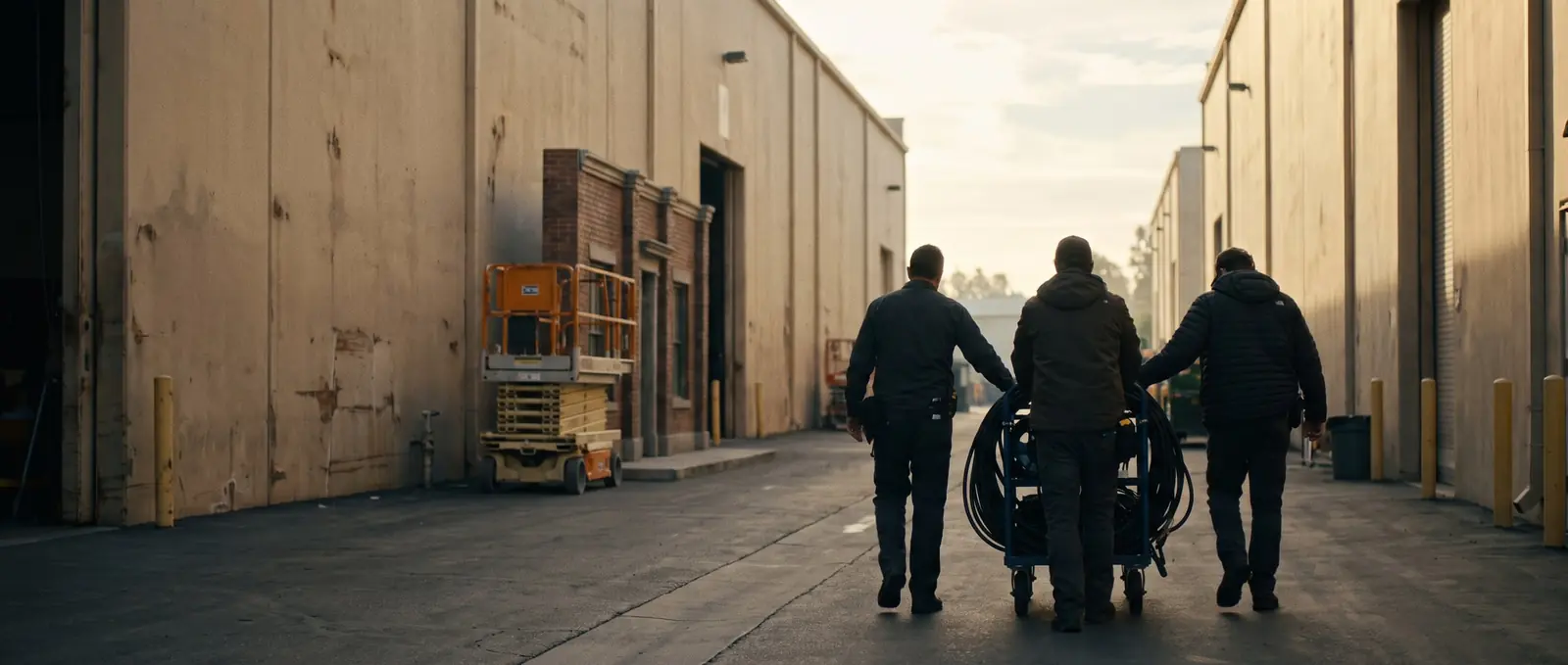

How do workers’ comp claims work for Burbank production crew?
A crew member hurt on a Burbank soundstage or backlot files a workers’ compensation claim like any other California employee. The first question a workers’ comp lawyer in Burbank asks, though, is which company actually employs you. Productions frequently hire through payroll services companies, and that company’s insurer usually receives the claim.
Stage work carries real physical risk. Crew members fall from ladders, lifts and perms, and loads drop during rigging. Others suffer cuts in the mill, burns, or electrical injuries around lighting. Days that run twelve hours or longer add fatigue to all of this. Short engagements create a further problem: an injured day-player may be off the payroll before the first doctor visit. As a result, an insurer can be slower to accept the claim.
- Tell the production in writing A text or email to the production office or your department head the same day creates a dated record.
- Ask for the first-aid record If a set medic or first-aid station treated you, ask the medic to write down the time and the cause.
- Overtime and company moves count An injury during a late turnaround, a company move between stages or a weekend call falls within the job like any other.
California gives you 30 days to report the injury to your employer under Labor Code § 5400. On a production that wraps in two weeks, however, waiting is risky, because the people who saw the accident scatter to other shows. The forms and deadlines for starting a claim are on the filing a workers’ comp claim page.
Can Burbank animators and editors claim workers’ comp for injuries that built up over time?
Yes. California recognizes cumulative trauma, an injury caused by repeated activity over a period of employment rather than a single event. Burbank’s animation and post-production studios employ many people whose work strains the hands, wrists, neck and back in exactly this way. A studio injury workers’ comp claim of this kind rarely starts with a dramatic moment. Instead, it starts with numb fingers at the end of a long cut.

Labor Code § 5412 fixes the date of injury for a cumulative claim. It is the date you first suffered disability and knew, or reasonably should have known, that work caused it. That date matters for deadlines and for which insurer pays. Freelancers who have moved between several studios may therefore have a claim that reaches back across more than one employer.
Insurers often dispute cumulative claims. Typically they argue that the condition comes from home computer use, age or hobbies. Those disputes usually end up before a qualified medical evaluator. The QME process page explains how that evaluator gets chosen and why the report carries so much weight.
Which Burbank workers outside the studios get hurt most often?
Outside entertainment, the airport, the hospital and the city’s large retail sector account for many Burbank work injuries. Each has its own employer arrangements.
At the airport
Most people who work at Hollywood Burbank Airport do not work for the airport authority. Instead, they work for airlines, ground-handling contractors, concessions or cleaning companies. Their claims go to their own employer’s insurer. Federal employees at the airport, by contrast, use the federal compensation system instead of California’s.
In hospitals and clinics
Healthcare workers at Providence Saint Joseph Medical Center and nearby medical offices face lifting injuries, needlesticks and exposure to infectious disease. An exposure claim turns on medical evidence linking the illness to the work. For that reason, the dates of the exposure and any incident reports matter.
In stores and warehouses
Retail and stockroom workers at Burbank’s shopping centers and big-box stores lift, climb and stand for whole shifts. Back injuries, knee injuries and falls from step stools make up a large share of these claims.
Whatever the workplace, a Burbank work injury claim follows the same statewide system. The workers’ compensation overview sets out the benefits, from medical care to temporary disability payments, before you get into the details of any single stage.
Which WCAB office hears a Burbank workers’ comp case?
Disputed Burbank claims go to a district office of the Workers’ Compensation Appeals Board in Los Angeles County. Labor Code § 5501.5 sets which offices can take a case. The choice depends on where you live, where you got hurt and where the employer does business.
For many Burbank workers, that means the Van Nuys district office, which hears cases from across the San Fernando Valley. Others go to the Los Angeles district office downtown. Hearings there include mandatory settlement conferences and expedited hearings on urgent treatment or benefit issues. Trials take place before a workers’ compensation judge. Many conferences now happen remotely, although some still require attendance in person.
When an insurer refuses the claim outright, the denied claims page walks through the steps to challenge the decision at the Board. A workers’ compensation attorney in Burbank can also ask for an expedited hearing when treatment has stopped.
What if someone other than your employer caused the injury?
Workers’ compensation generally bars a lawsuit against your own employer. It does not, however, protect other companies. On a busy Burbank lot, several vendors often share one stage. An injury caused by another company’s equipment or crew may therefore support a separate civil claim.
Consider a delivery driver rear-ended on the Golden State Freeway while working. Workers’ compensation pays benefits, and the at-fault driver’s insurer may owe more. The third-party claims page explains how the two recoveries interact. Meanwhile, the Burbank personal injury page covers the road and premises side.
What does a Burbank workers’ comp lawyer cost at this firm?
Hiring a workers’ comp lawyer for a Burbank claim costs nothing up front. A workers’ compensation judge at the WCAB approves the attorney’s fee, typically around 15%. It comes out of the award or settlement rather than your pocket. The fees and consultations page explains how the Board reviews the fee.
Veronica handles workers’ compensation intake, and the first consultation is free. It takes about thirty minutes, at the Glendale office on West Glenoaks Boulevard, by phone, or by video between shifts. Bring your call sheets or pay stubs if you have them, since they often show who the real employer is.