


Consular processing is the process of getting a green card through an immigrant visa issued at a US embassy or consulate abroad. After USCIS approves the family petition, the National Visa Center collects fees and documents, the embassy interviews the relative, and the relative enters the United States as a lawful permanent resident. It is the usual route for relatives who live outside the country.
Written and reviewed by
Last reviewed
| Who it is for | Relatives abroad, and relatives in the US who cannot adjust status |
|---|---|
| Agencies | USCIS, then the National Visa Center and the US embassy or consulate |
| Main form | Form DS-260, the online immigrant visa application |
| On arrival | Admitted as a permanent resident; the green card is mailed afterward |
| Attorney fee | A flat fee for the whole matter, agreed in writing before work begins |
| Government fees | Set by the Department of State and USCIS, paid separately |
Who goes through consular processing?
Relatives who live outside the United States use consular processing, and so do relatives inside the country who are not eligible to adjust status. Most spouses, parents, children and siblings abroad finish their cases this way.
The case starts the same way as any family immigration case, with an approved Form I-130 petition from US Citizenship and Immigration Services (USCIS). After approval, the file moves from USCIS to the Department of State. From there, the rest of the process runs through the National Visa Center (NVC) and a US embassy or consulate. USCIS summarizes the stages on its consular processing overview.
- Relatives living abroad The usual route for spouses, parents, children and siblings who have never lived in the United States.
- Relatives who entered without inspection They generally cannot use adjustment of status, so the case finishes at a consulate, often after a provisional waiver.
- Relatives who choose it Some people eligible to adjust still choose to finish abroad, for example when they already live overseas.
How does consular processing work?
Consular processing moves through a fixed sequence: petition approval, NVC processing, the medical exam, the interview, and entry. Each stage has to be complete before the next one starts.
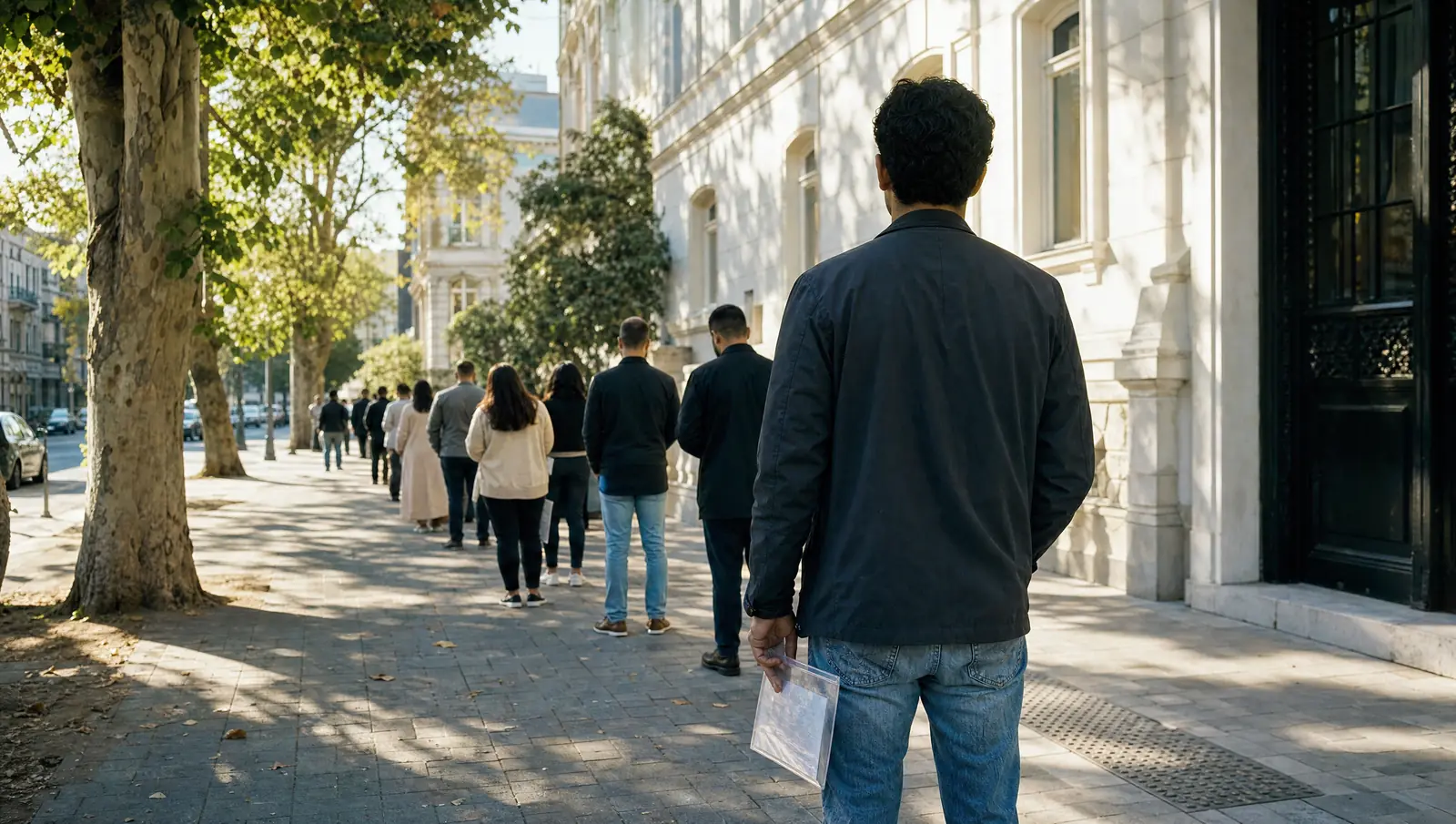
- Petition approved USCIS approves the I-130 and sends the file to the National Visa Center.
- NVC processing Through the Consular Electronic Application Center, the family pays the government fees, the relative completes Form DS-260, and both upload civil documents and the Form I-864 Affidavit of Support.
- Documentarily qualified Once NVC accepts everything, and a visa number is available, the case waits for an interview date at the embassy or consulate.
- Medical exam and interview The relative sees an embassy-approved panel physician, then attends the interview with original documents.
- Visa and entry If the officer approves it, the consulate places the immigrant visa in the passport. The relative enters the United States and an officer at the port of entry admits them as a permanent resident.
In a preference category, such as a petition for a brother or sister, the case can sit at the NVC stage for years. It moves only when the priority date becomes current. By contrast, immediate relatives of US citizens, including parents and unmarried minor children, do not wait for a visa number.
Where does the immigrant visa interview take place?
The interview usually takes place at the US embassy or consulate that handles immigrant visas for the relative’s country of residence. Not every embassy offers immigrant visa services. For that reason, the NVC assigns each consular processing case to a designated post.
Relatives living in Armenia generally have their interview at the US Embassy in Yerevan. Some countries, including Russia, have had limited immigrant visa services for years. As a result, the State Department usually assigns applicants there to a post in a neighboring country. It publishes the current designated post for each country, and that post can change.
An applicant who lives in a third country may be able to interview there, depending on the post’s rules for residents. The choice affects travel, police certificates and the medical exam. So it is part of planning the case from the start.
How long does consular processing take?
For an immediate relative, consular processing commonly takes many months after USCIS approves the I-130. The petition itself also takes time before that. In preference categories, however, the wait for a visa number usually dominates everything else.
The NVC stage moves as fast as the family can supply complete documents. After that, it moves as fast as NVC reviews them. Meanwhile, the interview stage depends on the embassy’s backlog, which differs widely from post to post.
The government sets processing times and changes them without notice. We will give you the realistic range for your relative’s embassy at the consultation, including the slow version.
What happens at the immigrant visa interview?
At the interview, a consular officer confirms the relative’s identity and reviews original documents. The officer then asks about the family relationship and the relative’s background under oath. Many interviews are brief.
The relative brings the appointment letter, passport, original civil documents and police certificates. Medical results, sealed or sent electronically, and any updated financial evidence complete the set. In marriage cases, the officer asks about the relationship in the same way USCIS would for a marriage green card filed inside the country.
At the end, the officer has three options. The officer can approve the visa, or refuse it under INA § 221(g) while the applicant supplies documents or administrative processing runs its course. Otherwise, the officer refuses it on a ground of inadmissibility under INA § 212(a).
What if your relative is in the United States now?
Consular processing is not always safe for a relative who is already here. A relative who has been in the United States without status for more than six months can trigger a bar on returning by leaving for the interview. The bar lasts three years after more than 180 days of unlawful presence, and ten years after a year or more.
A provisional unlawful presence waiver on Form I-601A lets many of these relatives apply for a waiver of that bar before they leave. That way, they know the answer before departing. It requires a US citizen or permanent resident spouse or parent who would suffer extreme hardship. The I-601 and I-601A waivers page explains how it works.
The provisional waiver covers only unlawful presence. It does not cover other grounds, such as a prior removal order, fraud or certain criminal history. In addition, some relatives entered or tried to enter without inspection after more than a year of unlawful presence. They may face a permanent bar that this waiver cannot address.
What goes wrong with consular processing?
Most consular problems are document problems, and most are visible in the file before the interview. The rest come from immigration or criminal history that nobody reviewed.
- The wrong civil documents Each country has specific required documents, listed in the Department of State’s reciprocity schedule. A birth record in the wrong format leads to a 221(g) refusal.
- An Affidavit of Support that falls short If the petitioner’s income is too low and no joint sponsor is ready, the consulate cannot issue the visa.
- Undisclosed history Prior visa refusals, overstays or arrests that were not disclosed on the DS-260 can turn into a misrepresentation finding.
- Administrative processing The consulate holds some cases for additional security review after the interview, with no fixed timeline.
What happens after your relative arrives?
Your relative becomes a lawful permanent resident on the day an officer admits them at a US port of entry on the immigrant visa. The stamped visa serves as temporary proof of status until the card arrives.
You have to pay the USCIS Immigrant Fee online before USCIS produces the physical green card. USCIS then mails the card to the US address given in the application. Some spouses were married less than two years when the consulate issued the visa. They receive a conditional two-year card and later file Form I-751, as our guide to removing conditions on residence with Form I-751 explains.
What does consular processing cost?
The firm quotes consular processing as a flat fee, agreed in writing before any work begins. The fee does not change because an embassy takes longer than expected. The Department of State and USCIS set the government fees, and you pay them separately, directly to the government. The fees and consultations page explains the flat-fee model.
The first consultation is free and takes about thirty minutes. We meet in person, by phone or by video, in English, Armenian, Russian or Spanish.