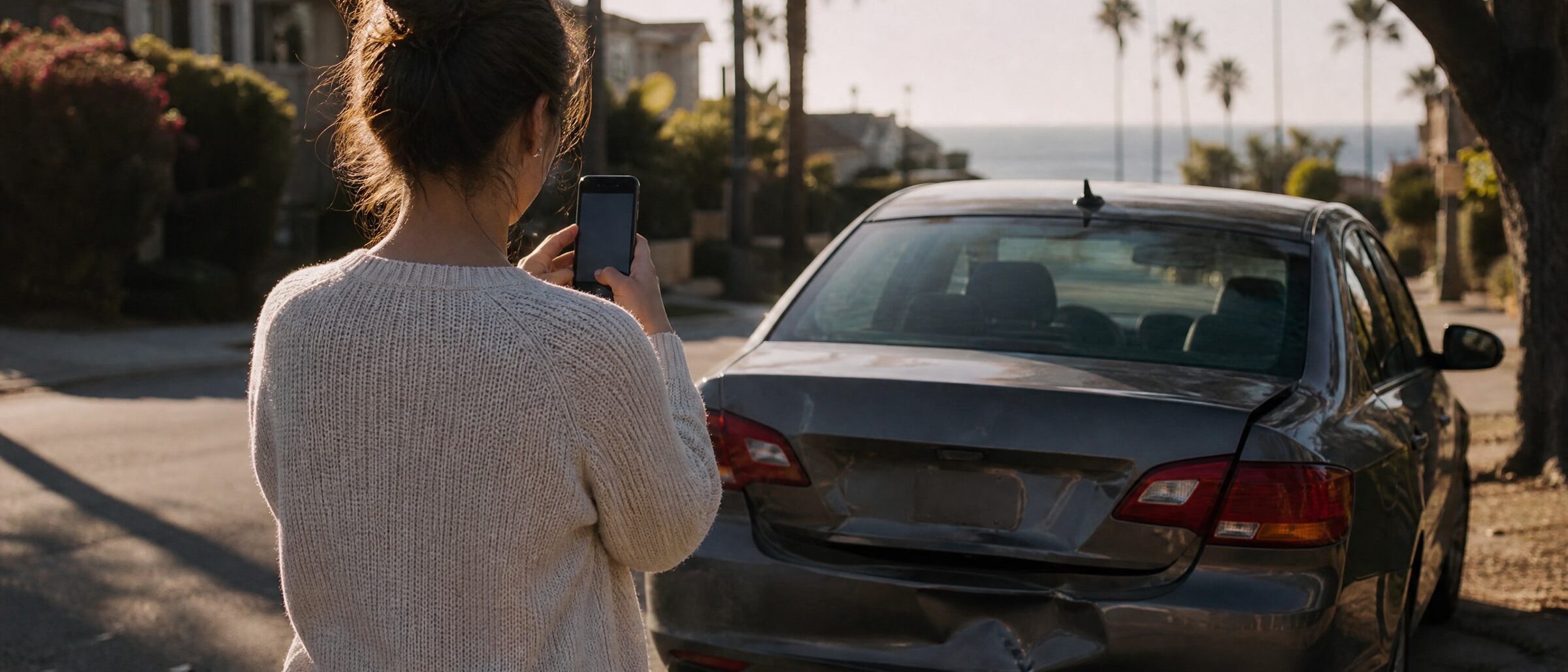
After an Uber accident in California, the first question is usually whose insurance pays, and the answer depends on what the driver’s app was doing at the moment of the crash. This guide is for passengers, other drivers, pedestrians, cyclists and rideshare drivers themselves. It explains each app stage, who you claim against, and what to do in the first days.
Which insurance applies at each app stage of a Lyft or Uber accident in California?
After any Uber accident in California, the law ties the insurance to three stages of the app. The coverage grows as the driver moves from personal driving to carrying a passenger.
The rules come from Public Utilities Code § 5433. The statute calls Uber, Lyft and similar services “transportation network companies,” and the California Public Utilities Commission regulates them.
- App off The driver is simply driving their own car. Their personal auto policy is the main source of coverage, just as in any other car accident claim.
- App on, waiting for a request The driver is logged on but has not accepted a ride. The law requires primary liability coverage at set minimums. The driver, the company, or both can supply it, and the company must carry excess coverage above those minimums.
- Ride accepted, through drop-off From the moment the driver accepts a request until the ride is complete, the law requires primary commercial coverage with much higher limits than typical personal coverage.
Two more rules help injured people. First, the rideshare policy does not wait for a personal auto insurer to deny the claim. Second, if the driver’s own coverage has lapsed, the company must provide the required coverage from the first dollar of the claim.
I was hurt in an Uber accident in California as a passenger. Who do I claim against?
If you were hurt in an Uber accident as a passenger, you are almost never the one at fault. So the question is only which driver caused the crash, and which policy stands behind that driver.
If your rideshare driver caused it, the claim goes to the commercial policy that covers accepted rides. That policy is primary, which means it responds first. If another driver caused it, the claim usually starts with that driver’s insurer. The rideshare coverage can still matter when the other driver has too little insurance or none at all.
Often, both drivers share some of the fault. In that case, California lets you claim against each of them for their share. Most Lyft accident claims and Uber claims work the same way, because the same statute governs both companies.
Your trip receipt matters in every Uber accident in California. It shows that you were a passenger in an accepted ride, which places the crash in the highest-coverage stage.
What if I was hit by an Uber driver in another car, on foot or on a bike?
If you were hit by an Uber driver, the app stage decides which policy answers for the driver. You do not need to know that stage on the day of an Uber accident in California, but the claim depends on it.
For example, a driver with the app off answers through a personal policy. A driver who was logged on and waiting answers through the waiting-stage coverage. A driver on the way to a pickup or carrying a rider answers through the commercial policy with the higher limits.
Drivers do not always say which stage applied. Therefore, it helps to note anything you saw, such as a phone mount showing the app or a trade dress sticker in the window. The rideshare company keeps the log-in and trip data, and a claim or lawsuit can ask for it. Pedestrians and cyclists who were hit by an Uber driver follow the same stage rules as other drivers.
What if the other driver in a California Uber accident had no insurance?
While a passenger is in the car, the rideshare company must provide uninsured and underinsured motorist coverage. That coverage is primary over other uninsured motorist coverage, and it is the company’s obligation alone.
Timing matters. The current text of § 5433 applies this coverage “from the moment a passenger enters the vehicle” until the passenger exits. The legislature amended the section in 2025, in SB 371, effective January 1, 2026. As a result, articles written before 2026 may describe this coverage differently. The statute states the limits in words and numbers, and they are lower than the liability coverage for accepted rides.
Your own policy may also help. Under Insurance Code § 11580.2, California auto policies include uninsured motorist coverage unless the policyholder waived it in writing. Whether your policy adds to the rideshare coverage depends on its terms.
I am an injured Uber driver. Does Prop 22 insurance replace workers’ comp?
For most rideshare drivers, yes. Proposition 22 treats app-based drivers as independent contractors when the company meets certain conditions, so workers’ compensation generally does not cover the driving. Instead, the company must provide occupational accident insurance.
Who counts as an independent contractor
Under Business and Professions Code § 7451, a driver is an independent contractor if the company does not set their hours, does not require them to accept any ride, lets them drive for other apps, and lets them work in other jobs. The California Supreme Court upheld Proposition 22 in 2024, so these rules remain in force.
What the occupational accident insurance covers
Business and Professions Code § 7455 requires coverage for injuries that happen while the driver is online. That means logged on and able to receive requests, or on a trip.
- Medical expenses Coverage for medical costs, up to a high limit that the statute sets.
- Disability payments Payments equal to 66 percent of average weekly earnings from all apps, for up to 104 weeks after the injury.
- Death benefits Accidental death coverage for dependents, with benefits measured by the Labor Code’s workers’ compensation rules.
However, the coverage has limits. It need not cover a crash while you are online but not on a trip, if you were engaged on another app or doing something personal at the time.
Claims against the other driver
If another driver caused the crash, an injured Uber driver can generally bring a claim against that driver too, like anyone else hurt on the road. The occupational accident policy’s terms can affect how the two recoveries interact. If you also work as an employee in a separate job and were hurt doing that job, workers’ compensation applies to that employer in the usual way.
Do I need to report a rideshare accident in California to the app, police or DMV?
After an Uber accident in California, report it in three places when they apply: in the app, to the police, and to the DMV. Each report serves a different purpose, and none replaces another.
- In the app Both Uber and Lyft let riders and drivers report a crash through the app. This opens a file and ties the crash to a specific trip.
- To the police For a crash with injuries, call 911 or the local police or CHP. A police report records the scene, the parties and any witness details.
- To the DMV Each driver must file the SR-1 Report of Traffic Accident within 10 days if the crash injured or killed anyone, or if property damage exceeds the threshold printed on the form. The duty applies regardless of fault, and a police report does not satisfy it.
Passengers are not drivers, so the SR-1 duty falls on the drivers. Still, the DMV form lets a passenger file and mark themselves as the passenger.
Should I give a recorded statement to the rideshare insurer?
The law does not generally require you to give a recorded statement to an insurer that covers someone else. The rideshare company’s insurer may call within days, and its adjuster works for the company and the driver, not for you.
Adjusters often ask how you feel, whether you were looking at your phone, and whether you had earlier injuries. Early answers can be incomplete, because many injuries take days to show. Your own insurer is different: your policy likely requires you to cooperate. Our page on giving a statement to an insurer explains what to expect on those calls.
What evidence should I save after a rideshare accident in California?
After an Uber accident in California, save anything that shows the app stage, the scene and your injuries. App records can change or become harder to reach later, so screenshots taken early are useful.
- Trip receipt and ride history The emailed receipt and in-app history show the time, route and driver.
- Screenshots Capture the driver’s profile, the car details and any messages exchanged in the app.
- Dashcam and phone video Many rideshare drivers run dashcams. Ask for footage early, and keep your own photos of the vehicles and the scene.
- Witness names Write down names and phone numbers before people leave.
- Medical records Keep every visit summary, prescription and work note from the first day onward.
Also, see a doctor promptly, even for pain that seems minor. A gap in treatment is one of the first things an adjuster points to. The same records support Lyft accident claims and Uber claims alike.

How long do I have to file an Uber accident claim in California?
In most cases, you have two years from the date of the crash to file a lawsuit for your injuries. The rule comes from Code of Civil Procedure § 335.1.
A much shorter deadline applies if a public vehicle was involved, such as a city bus or a county truck. Then a written claim must go to the public entity within six months, under Government Code § 911.2. Insurance talks do not pause either deadline. Our page on personal injury deadlines covers the exceptions.
Most rideshare claims settle without trial. Our overview of how injury settlements work walks through that process step by step.
Frequently asked questions
Can I sue Uber directly after an accident in California?
Sometimes, but most claims run through the insurance the company must carry, not a suit against the company itself. Under Proposition 22, rideshare drivers are generally independent contractors, which limits when the company answers for a driver’s mistakes. The statute also says the insurance rules do not cap the company’s liability where some other legal basis exists. An attorney can tell you whether your facts support a direct claim.
Does my own car insurance matter if I was a rideshare passenger?
It can. If the at-fault driver has no insurance or too little, the rideshare company’s uninsured motorist coverage comes first while you are in the car. Your own policy’s uninsured motorist or medical payments coverage may apply after that, depending on its terms. Read your declarations page, and report the crash to your insurer as the policy requires.
What if the rideshare driver says the app was off?
The app status is a question of fact, and the rideshare company keeps the records that answer it. Your trip receipt, ride history screenshots and any messages from the driver help show the stage of the trip. If the driver was logged on or carrying you as a passenger, the rideshare coverage applies even if the driver says otherwise.
Can an injured Uber driver get workers’ compensation?
Usually not for the driving itself. Proposition 22 treats app-based drivers as independent contractors when the company meets certain conditions, and the California Supreme Court upheld the measure in 2024. Instead, the company must provide occupational accident insurance for injuries while online. A driver who also has a regular job is still covered by workers’ compensation for injuries in that job.
How long does a rideshare injury claim take?
It varies with the injuries, the number of insurers involved and whether fault is disputed. Many claims wait until your treatment reaches a stable point, so everyone knows the full extent of the injury before any settlement talks. The two-year filing deadline keeps running during negotiations, so the claim has to stay on track even while talks continue.
Do I have to pay anything up front to hire a lawyer?
No. Petrosyan Law Group handles injury cases on a 33% contingency fee, and there is no attorney’s fee unless there is a recovery. You may still be responsible for case costs and expenses, such as records fees or filing fees, and the written fee agreement explains how those work before you sign.
How Petrosyan Law Group can help
Petrosyan Law Group handles personal injury cases for passengers, other drivers, pedestrians and rideshare drivers. We identify the app stage, request the company’s records, and deal with each insurer so you can focus on recovery.
The fee is a 33% contingency, and there is no attorney’s fee unless there is a recovery. You may still be responsible for case costs and expenses. The first consultation is free and takes about thirty minutes, in person in Glendale, by phone or by video. You can book a consultation in English, Armenian, Russian or Spanish.
This article is general information, not legal advice for your situation, and reading it does not create an attorney–client relationship.
Sources
- California Public Utilities Code § 5433
- California Business and Professions Code § 7451
- California Business and Professions Code § 7455
- California Insurance Code § 11580.2
- California Code of Civil Procedure § 335.1
- California Government Code § 911.2
- California Public Utilities Commission: Transportation Network Companies
- California DMV: Report of Traffic Accident Occurring in California (SR-1)